The Partnership Playbook: Vol. 3
End-of-Year Feedback & Summer Planning: Finishing Strong and Looking Ahead

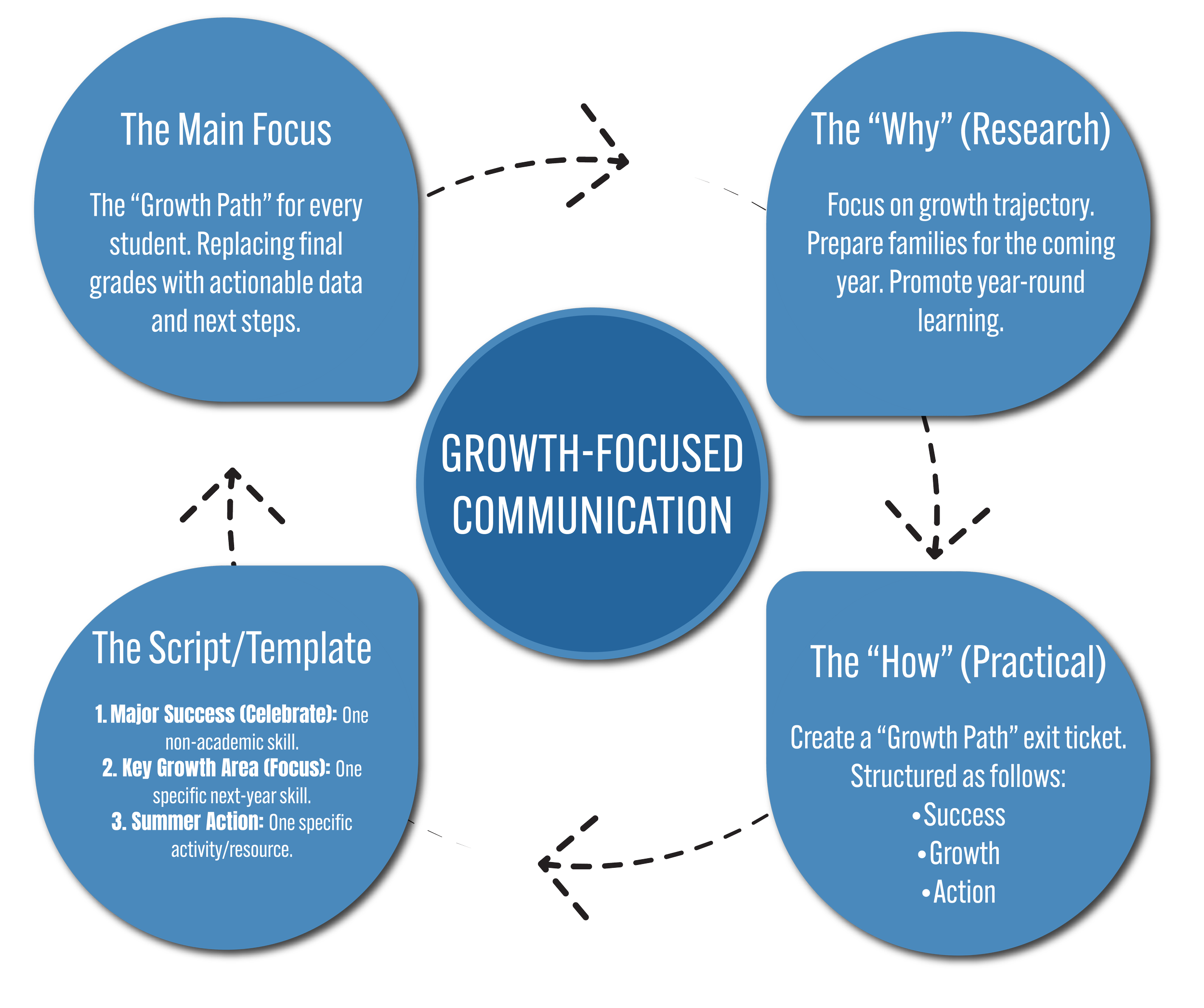
We’ve reached the end of the year! This is the most crucial time to solidify the partnership by giving families actionable, forward-looking information. Our goal now is two-fold: First, to provide closure by delivering honest, concise feedback that celebrates growth over the entire year, and Second, to prepare students and families for a smooth transition to the next grade level and a successful summer of learning.
We need to avoid dumping a year's worth of paperwork on parents in May. Instead, let's focus on a high-impact "1-2-3 Summer Plan" for every student. By providing clear guidance on what to practice, what to read, and what to expect next, we ensure that the learning partnership doesn't end with the final bell. Let's finish strong!

The Forward-Looking Feedback Loop

The "Year-End Thank You"
Goal: Cementing Positive Relationships
Ending the year with gratitude reinforces the partnership tone established in Vol #1.
Tip: Send a brief, generic, but warm "Thank You" to all families for their support of the classroom as a whole.
Example:
“Thank you for all your support this year! Your partnership made a real difference in our classroom's success. Have a wonderful and restful summer. We look forward to hearing about your child's successes next year!" (Send this via your general class platform.)

The “Incoming Teacher Q&A”
Tool Highlight: Easing Transition Anxiety
Anxiety about the next teacher/grade level is a major contributor to disengagement over the summer.
Tip: Work with the teacher of the next grade level (or department chair) to create a short, shared digital Q&A or a brief video.
Practical Application: Share the link with your outgoing families. Content should be simple:
"Meet Ms. Jones, your 4th-grade teacher! She loves teaching science and reading fantasy books."This helps personalize the transition and reduces parental worry.
High School Adaptation: Scaling Transition & Feedback
For high school, end-of-year communication must focus heavily on prerequisites, future course alignment, and self-advocacy skills.
1. Scaling the Feedback: The "Skill Transfer" Summary
Best Practice: Final feedback should connect the skills learned in your course to the skills needed in the next required course (e.g., Algebra I to Geometry).
Practical Application - The “Next Level Advice” Email
For your final feedback to parents, include a sentence or two detailing the single most important skill the student must retain or practice for success in the next course.
Example (from English 9): "For success in English 10, [Student Name] must focus on integrating evidence correctly into their claims. I recommend practicing this over the summer by reading nonfiction articles and summarizing the main point with 2-3 quotes."
2. High School Quick-Tip: The "Summer Self-Advocacy Checklist”
Tip: Instead of telling parents what they should do, give the student a brief checklist for self-advocacy to complete over the summer.
Checklist Items:*
Research your required reading books.
Write down your ideal fall schedule.
Look up your next teacher's name.
*The family's job is to ensure the student completes the checklist.
3. Leveraging Final Grades as Feedback
Tip: When final grades are posted, send one last communication reminding parents where they can view the full final grade breakdown and the school’s policy for incomplete or low grades.
Impact: This directs families to the permanent record, holds students accountable for their final grades, and proactively addresses common end-of-year questions.
4. The Parent Perspective: A Reality Check
Parent Quote:"I love when they send home a list of summer reading, but I really wish they'd also tell me what specific math skills my child should practice, because I'm worried about the 'summer slide.'"
Teacher Takeaway: This quote confirms that families are actively seeking practical, academic guidance. The Growth Path Exit Ticket directly addresses this need by providing that crucial Summer Action step, moving beyond generic advice.

Supporting Transitions
1. Systemize the Hand-Off
Action for Administration: Establish a simple, required end-of-year communication protocol where the outgoing teacher sends the incoming teacher one line of positive, asset-based information about each student (e.g., "Enjoys group work and is very helpful during transitions").
The Impact: This immediately sets the incoming teacher up to start Vol. 1’s "First Contact" on a positive note, carrying the growth mindset forward.
2. Promote Unified Summer Resources
Action for Administration: Consolidate all teacher-recommended summer reading lists, practice apps, and academic resources into one easily accessible page on the school's website (the "Summer Learning Hub").
The Impact: This ensures consistency, simplifies communication for all teachers, and provides families with a single, trusted resource point throughout the break.
TDA and Nonprofits Help Meet the Need for Summer Nutrition

Commissioner
Sid Miller
When school cafeterias close for summer, the Texas Department of Agriculture (TDA) partners with the nonprofit organizations operating U.S. Department of Agriculture Summer Meal Programs. The nonprofits serve meals at recreation centers, church facilities, schools, and other venues. Children 18 and younger can access meals at these facilities for no charge.
As your Texas Agriculture Commissioner, I’m proud to partner with these organizations, and I encourage you to join me in supporting their efforts by telling families about the Summer Meal Programs and how to find a meal site convenient for them.
From June 1 to August 30, families are invited to call or visit online through the following options to discover how to access healthy meals for young Texans:
Call 211 to speak to an operator
In addition to locating a site, it’s important to use these tools to confirm dates and times and gather more information about meal services. Some locations in rural areas will distribute multi-day meal bundles for families who have trouble attending a site daily. Utilizing these site-finding tools will provide families in remote and underserved areas with information about nearby sites that offer these accommodations.
TDA provides resources you can download and distribute or display in high-traffic areas to alert families to the tools for finding a nearby site. Visit SquareMeals.org/SummerResources to access the resources. Please help me ensure more children have access to healthy meals this summer. Working together, TDA and you can have a big impact and build a healthier future for the Lone Star State.


1. For the “Summer Planners”
"Lasting Consequences of the Summer Learning Gap" by Alexander, K. L., Entwisle, D. R., & Olson, L. S.
Why: This is a key resource for understanding the “Summer Slide” and the long-term impact of academic loss during break periods.
"Smarter Summers, Brighter Futures: A Guide for Educators" by the National Summer Learning Association.
Why: This guide supports implementation of the “1-2-3 Summer Plan” and the development of unified Summer Learning Hubs.
2. For Feedback & Assessment
"Visible Learning: A Synthesis of Over 800 Meta-Analyses Relating to Achievement" by Hattie, J.
Why: This resource contains evidence-based support for growth-focused feedback, with a highlight on why focusing on the learning process outperforms simple evaluative grades.
3. For Systematic Family Engagement
"A New Wave of Evidence: The Impact of School, Family, and Community Connections on Student Achievement" by Anne Henderson and Dr. Karen Mapp.
Why: This is the foundational framework for the “Partnership Playbook,” emphasizing the link between family engagement and student success.
"Dual Capacity-Building Framework for Family-School Partnerships" by Mapp, K. L., and Bergman, E.
Why: This is a practical guidance for administrators on systemizing communication and building staff capacity for effective hand-offs.
4. For High School Readiness
"Problem Solving and Postsecondary Preparedness" by Schoenfeld, A. H.
Why: This focuses on high school prerequisites and the importance of summarizing specific skill transfers for next-level course success.
Works Cited:
Alexander, Karl L., Doris R. Entwisle, and Linda Steffel Olson. "Lasting Consequences of the Summer Learning Gap." American Sociological Review, vol. 72, no. 2, 2007, pp. 167-180. (Supports the "Reality Check" section regarding the 'Summer Slide' and academic loss).
Henderson, Anne T., and Karen L. Mapp. A New Wave of Evidence: The Impact of School, Family, and Community Connections on Student Achievement. National Center for Family and Community Connections with Schools, 2002. (Supports the overall "Partnership" framework and the importance of year-round family engagement).
Hattie, John. Visible Learning: A Synthesis of Over 800 Meta-Analyses Relating to Achievement. Routledge, 2009. (Supports the "Forward-Looking Feedback" section, specifically how feedback on the learning process/growth trajectory outperforms simple evaluative grades).
Mapp, Karen L., and E. Bergman. "Dual Capacity-Building Framework for Family-School Partnerships (Version 2)." Dual Capacity, 2019, www.dualcapacity.org. (Supports the "Principal’s Partnership Pointers" on systemizing communication and building staff/family capacity).
National Summer Learning Association. "Smarter Summers, Brighter Futures: A Guide for Educators." NSLA Resources, 2023. (Supports the "1-2-3 Summer Plan" and the creation of a "Summer Learning Hub").
Schoenfeld, Alan H. "Problem Solving and Postsecondary Preparedness." The Mathematics Teacher, vol. 105, no. 8, 2012. (Supports the High School Adaptation section regarding prerequisites and skill transfer summary).