
The Partnership Playbook: Vol. 2
Conferences & Positive Outreach:
Maximizing the Meeting

As we move into the busiest season for formal communication—parent-teacher conferences—the goal shifts from initial contact to sustained collaboration. In our first issue, we focused on setting a positive, asset-based tone. Now, we’ll put that foundation to use.
This edition equips you with strategies to make your conference time high-impact and low-stress. The most effective conferences aren't about reporting grades; they are about co-creating solutions and ensuring the student, the family, and you are all aligned on a single, measurable goal for the next semester. We’ll also share tips to maintain the habit of positive outreach right through the holidays. Let’s make every minute of that meeting count!

The Collaborative Conference
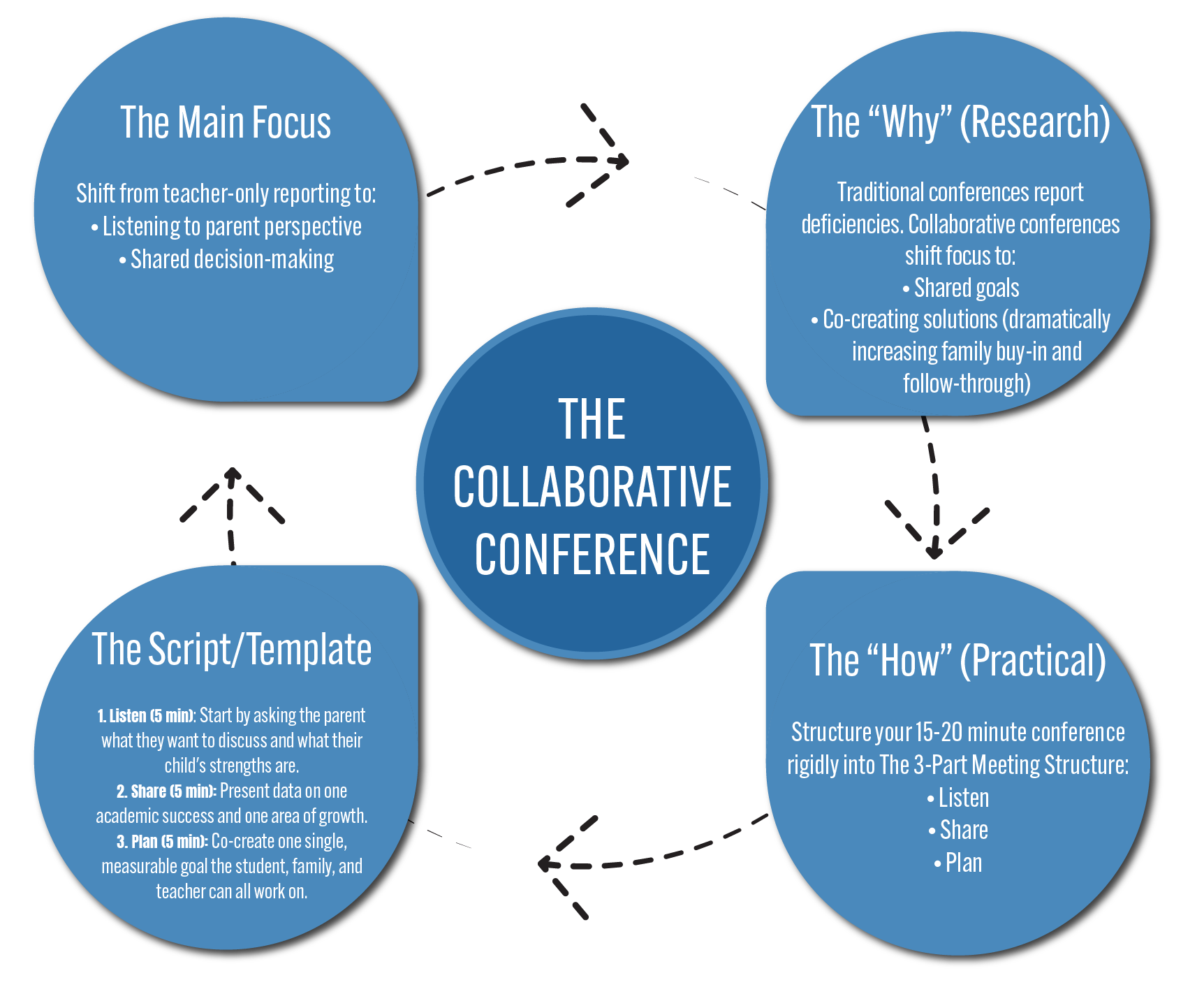
Research shows that traditional conferences often focus solely on the teacher reporting student deficiencies. By shifting to a "Two-Way Street" model, you move the focus toward shared goals and co-creating solutions, which dramatically increases family buy-in and long-term follow-through. You are appearing as a collaborator, not a critic.
Your Actionable Tip: Structure your 15–20 minute conference rigidly into three distinct 5-minute parts: Listen, Share, and Plan.
The 3-Part Meeting Structure
(For a 15-minute face-to-face or virtual conference)
Listen (5 min): Start by asking the parent what they want to discuss and what their child’s strengths are.
Sample Lead-in: "To make sure we use our time well, what is one thing you’d love to discuss today? Also, what are some strengths you see in [Student Name] at home?"
Share (5 min): Present data on exactly one academic success and one specific area of growth.
Sample Lead-in: "Looking at our classroom data, I’ve seen [Student Name] really excel in [Success]. One area where we can provide some extra support to see more growth is [Area of Growth]."
Plan (5 min): Co-create one single, measurable goal that the student, family, and teacher can all work on together.
Sample Lead-in: "Based on what we’ve both seen, let’s pick one goal for the next month. If we focus on [Specific Goal], what is one way we can each support [Student Name] this week?"

The "Data Point, Not a Personality Trait"
Goal: Framing Concerns Objectively
When discussing a challenge, using subjective language (e.g., "He is lazy," "She is disruptive") puts the parent on the defensive.
Tip: When preparing for a tough conference, ensure every concern is tied to a specific, observable data point.
Example Revision:
Instead of saying,
“She interrupts, constantly.”
try,
“In group work, this week, [Student Name] interrupted peers or spoke out of turn 7 times in a 30-minute period.”
This allows you to discuss behavior without attacking character.

The Conference Confirmation
Tool Highlight: Simple Scheduling & Pre-Work
Save time and ensure families arrive prepared.
Tip: Use a free tool like Sign-Up Genius or your school’s scheduling app to let parents book their conference time.
Practical Application: In the confirmation email, include a one-sentence reminder of your collaborative focus: "I look forward to our meeting, where we will celebrate your child's progress and jointly set one goal for the next semester."
High School Adaptation: Scaling Conferences & Data Sharing
The focus remains on collaboration, but the method shifts from a long meeting to a high-impact, focused conversation that leverages digital data.
1. Scaling the Collaborative Conference: The "Pre-Meeting Data Drop"
Best Practice: Pre-load the conversation with data so the meeting time is spent on action, not review.
Practical Application: Send a brief, individualized email 24-48 hours before the conference containing a link to the student's current grades/missing assignments page and state the single focus goal you want to discuss (e.g., "We will be discussing how to improve the quality of lab report conclusions.").
2. High School Quick-Tip: The "Digital Portfolio Share"
Tip: Prior to conferences, ask students to select their one best piece of work from the grading period and upload it to a shared, private folder.
Conference Use: Use this one piece of evidence during the meeting to show the family the student's potential and use it as a benchmark when setting their single growth goal.
3. Making Progress Reports Actionable
Tip: When sending automated progress reports, include a generic, templated line personalized to your course: "Please check [Your Online Gradebook Link] for details. If you have any questions about assignments, please ask your student to use my office hours on Tuesday and Thursday after school." This reinforces student accountability.
4. The Parent Perspective: A Reality Check
Parent Quote: "I spent the whole night before the conference worrying I was going to be blamed for my child's poor grades. I felt like I was being called to the principal's office."
Teacher Takeaway: This quote shows the high anxiety many parents feel. Lead with a positive statement and strictly adhere to the "Listen" part of the 3-Part Meeting Structure. Frame the meeting as an opportunity to pool resources, not to assign blame.

Supporting Conferences
1. Provide a "Prep Day" Time Block
Action for Administration: Schedule an hour-long mandatory prep block for all teachers a few days before conferences begin. Use this time for teachers to organize their data and finalize their single focus goal for each student.
The Impact: This ensures teachers walk into the conference feeling prepared and professional, validating the time investment.
2. Resource the Space
Action for Administration: Ensure there are dedicated, private, and visually appealing spaces for conferences. Provide snacks/water for teachers working late, and ensure translation/bilingual services are easily accessible (in-person or via tablet) if needed.
The Impact: Shows teachers that the administration recognizes conferences as a high-stakes event and supports the effort required.
Steve and Peggie Constantino explore why authentic relationships are the essential foundation of family engagement. Listen to their podcast here.

1. For the "Collaborative Mindset" (The Big Picture)
"Everyone Wins! The Evidence for Family-School Partnerships & Student Success" by Anne T. Henderson and Karen L. Mapp.
Why: This is the "gold standard" for understanding why family engagement isn't just a "nice-to-have," but a core driver of student achievement.
"Beyond the Bake Sale: The Essential Guide to Family-School Partnerships" by Anne T. Henderson, et al.
Why: Practical strategies for transforming school culture from "fortress schools" to "open doors."
2. For High-Impact Conferences (The "How-To")
"Crucial Conversations: Tools for Talking When Stakes Are High" by Patterson, Grenny, McMillan, and Switzler.
Why: Essential for the "Data Point, Not a Personality Trait" section. It teaches how to stay in "dialogue" when emotions (or defensive parents) enter the room.
3. For High School & Data Scaling
Why: Supports the "High School Adaptation" of your playbook by involving the student as a primary stakeholder in the data narrative.
Works Cited:
Epstein, J. L. (2018). School, Family, and Community Partnerships: Preparing Educators and Improving Schools. Routledge.
Supports the "Two-Way Street" concept by defining six types of involvement that bridge the gap between home and classroom.
Ferlazzo, L. (2011). Helping Students Motivate Themselves: Practical Answers to Classroom Challenges. Eye On Education.
Provides the basis for "Actionable Progress Reports" and shifting accountability to the student in a supportive way.
Harvard Family Research Project. (2010). Parent–Teacher Conferences: A Tip Sheet for Principals, Teachers, and Parents.
Validates the "Principal’s Partnership Pointers" regarding the importance of physical space and preparation time.
Mapp, K. L., & Bergman, E. (2019). Dual Capacity-Building Framework for Family-School Partnerships (Version 2).
The theoretical backbone for the "Listen, Share, Plan" structure, ensuring both teachers and parents feel capable of collaborating.
Stone, D., & Heen, S. (2014). Thanks for the Feedback: The Science and Art of Receiving Feedback Well. Viking.
A deep dive into why "Personality Traits" trigger defensiveness and how to use "Data Points" to keep the learner (and parent) engaged.