The Partnership Playbook: Volume 1

Welcome to The Partnership Playbook!
As educators, we know the single greatest predictor of student success is not a curriculum or a test score—it's the strength of the relationship between the classroom, the student, and the family. Yet, in the whirlwind of back-to-school demands, developing these critical partnerships often feels like one more item added to an already overwhelming list. That’s where this newsletter comes in.
We are here to simplify and amplify your efforts. This resource is designed by educators for educators, offering high-impact, low-lift strategies. We will move past the general idea of "good communication" and provide you with ready-to-use scripts, templates, and actionable tips that honor the expertise of both the teacher and the family.
Our goal is to shift the parent-teacher dynamic from transactional (problem-focused) to transformational (asset-focused). Starting now, let's build bridges, not barriers, and make every family feel like a valued co-educator in their child's journey. Let's make this year the strongest yet for family engagement!

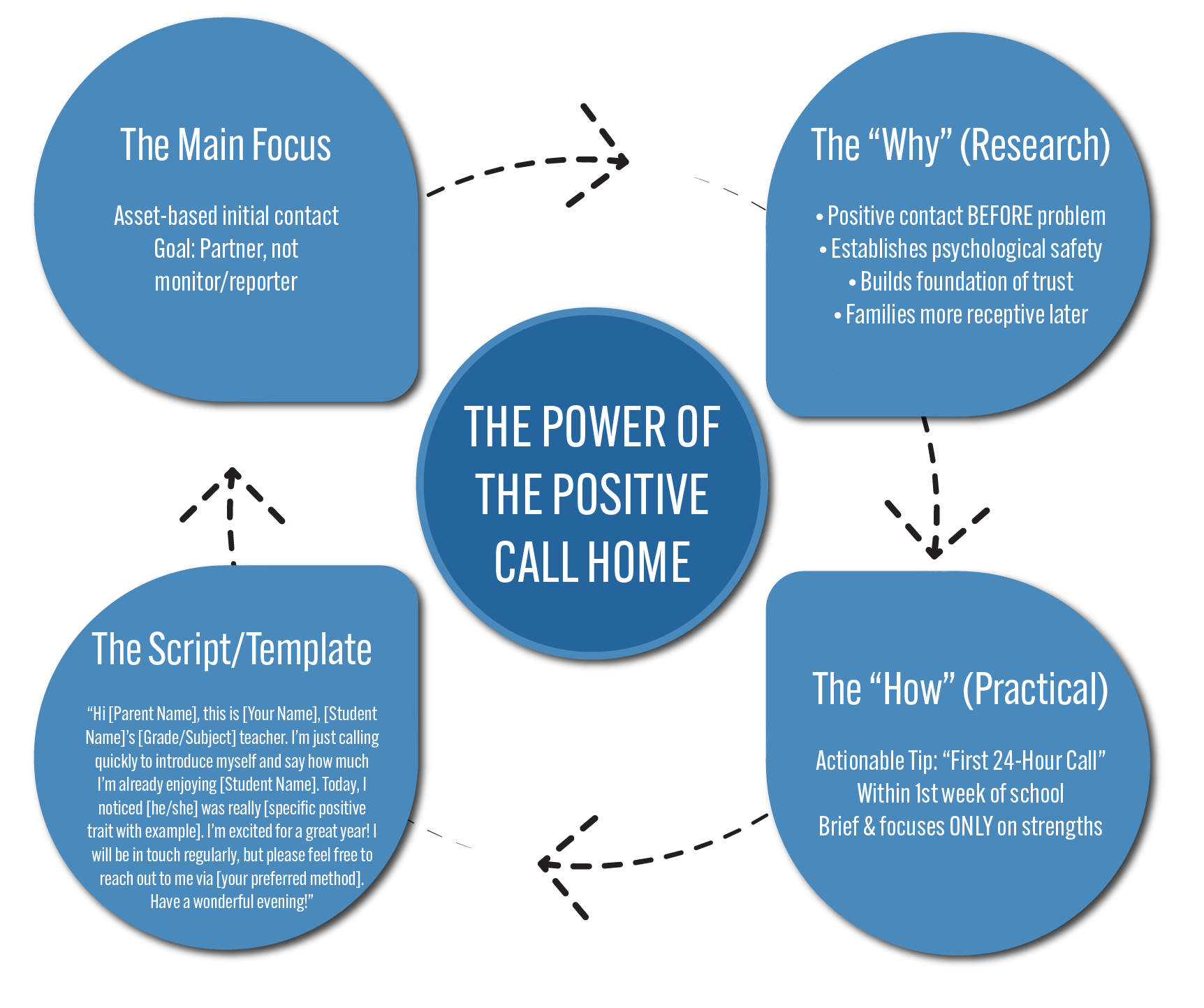
The Power of the Positive Call Home
Research consistently shows that when a teacher reaches out positively before a problem arises, they establish psychological safety and a foundation of trust. This makes families significantly more receptive to difficult conversations later on. We are introducing ourselves as a partner, not a monitor or reporter.
Your Actionable Tip: Commit to the "First 24-Hour Call" (or email/text) for every student within the first week of school. Keep it brief and focused on family strengths.
Script/Template
(For a phone call, leave a voicemail if needed)
"Hi [Parent Name], this is [Your Name], [Student Name]'s [Grade/Subject] teacher. I'm just calling quickly to introduce myself and say how much I'm already enjoying [Student Name]. Today, I noticed [he/she] was really [specific positive trait, e.g., helpful during cleanup, showing great focus on the math puzzle, or very polite to a classmate]. I’m excited for a great year! I will be in touch regularly, but please feel free to reach out to me via [your preferred method]. Have a wonderful evening!"

The "Home Input" Survey
Goal: Harnessing Family Expertise
Teachers are experts in instruction, but families are the experts in their child. Start the year by collecting valuable insights that guide your instruction and connection efforts.
Tip: Send a short, 3-question survey home (or use a quick digital form) asking families to share high-leverage information about their child.
Sample Questions:
What is one thing that genuinely excites your child about learning (e.g., reading non-fiction, building things, nature)?
What is the best way and best time for me to contact you quickly with a positive update?
What is one piece of advice you’d give me for helping your child stay motivated or focused this year?

The Communication Grid
Tool Highlight: Organizing Contact
Effective partnership requires timely and appropriate communication. Use this grid as your guide to choose the right channel for the right purpose.
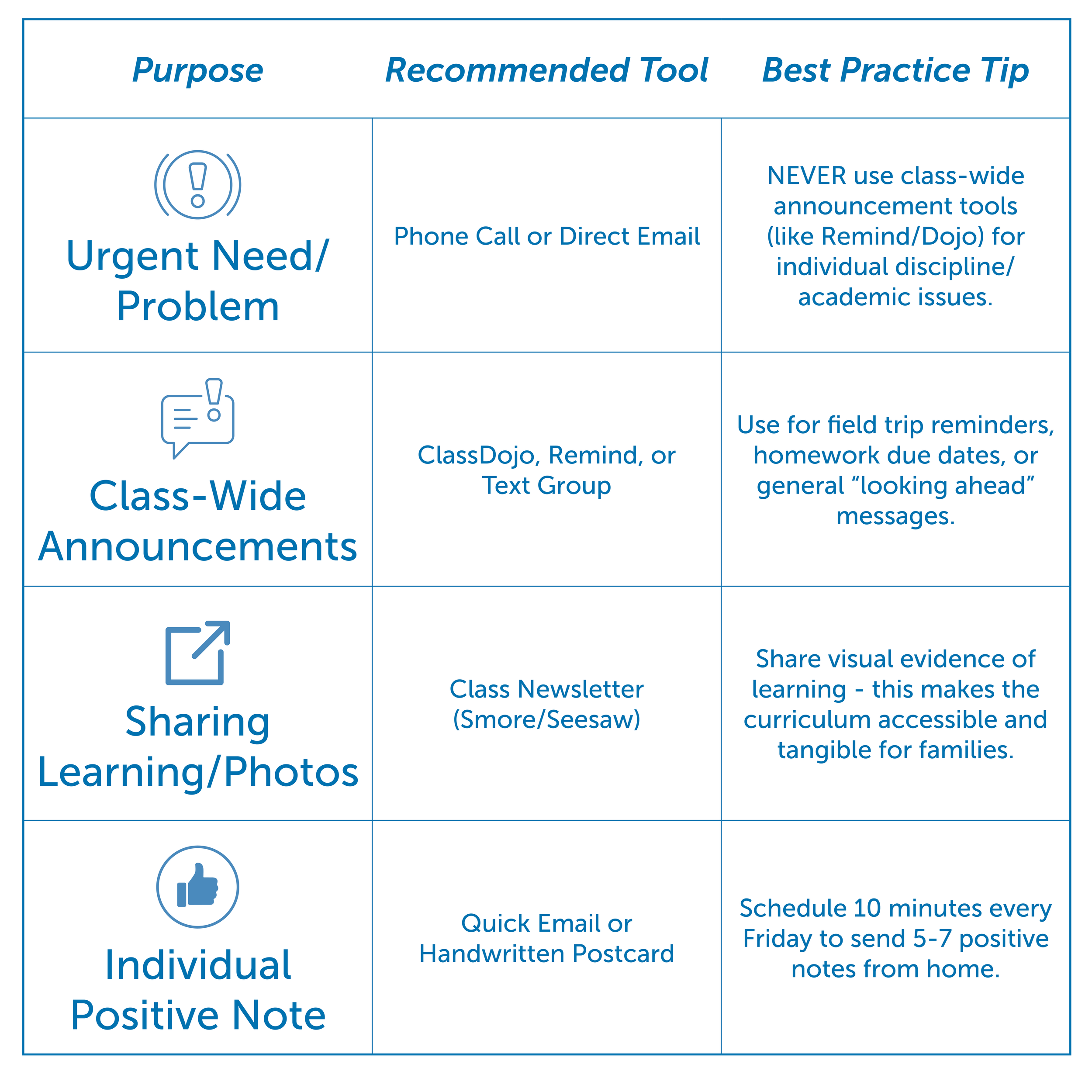
High School Adaptation: Scaling Communication (150+ Students)
The strategies for establishing positive connections are vital in high school, but they must be managed efficiently across multiple classes. Here is how to scale the "Launch & First Contact" efforts for a secondary caseload.
1. Scaling the "Positive Contact": The "First 20 Focus"
Best Practice: Leverage digital tools to make batch contact that feels personal.
Practical Application: Focus on 20 students per week for five weeks to reach every student once. Use a personalized email or text (via a secure school platform) to quickly drop in a student's name and a positive observation you noticed in class.
2. Scaling the "Home Input" Survey
Tip: Embed the 3-question "Home Input" Survey directly into your Course Syllabus or Back-to-School Night Handout.
Focus on Logistics: Simplify the questions to focus on preferred communication, not deep learning styles. Example: "What is the single best email address for me to send important updates about your student's progress?"
3. Grading Platform as a Partnership Tool
Tip: Commit to updating your grade book every Friday by 4 PM.
Impact: Consistent, timely updates are communication. They allow the family and student to proactively manage their work before the issue requires a direct intervention from you.
4. The Parent Perspective: A Reality Check
Parent Quote: "I dread calls from the school because they are always bad news. I just assume they're calling to tell me what my child did wrong now."
Teacher Takeaway: This quote perfectly underscores the necessity of the positive initial call. Your positive outreach acts as a reset button, helping parents view a call from you as a source of good news, not anxiety.

Leadership Strategies to Supercharge Family Engagement
Family engagement is not just a teacher responsibility; it's a campus-wide priority.
1. Validate the Time Investment
Action for Administration: Acknowledge and praise positive outreach publicly. In staff meetings, share anonymous examples of teachers making positive calls and explain why that effort is valued as instructional support.
2. Resource the Effort
Action for Administration: Provide basic translation resources (e.g., access to a dedicated translation app or print-outs of common phrases in key home languages). This removes a major communication barrier for teachers.
3. Model the Partnership Tone
Action for Administration: Review front-office scripts and procedures to ensure every interaction with a parent or guardian is welcoming, respectful, and asset-based.
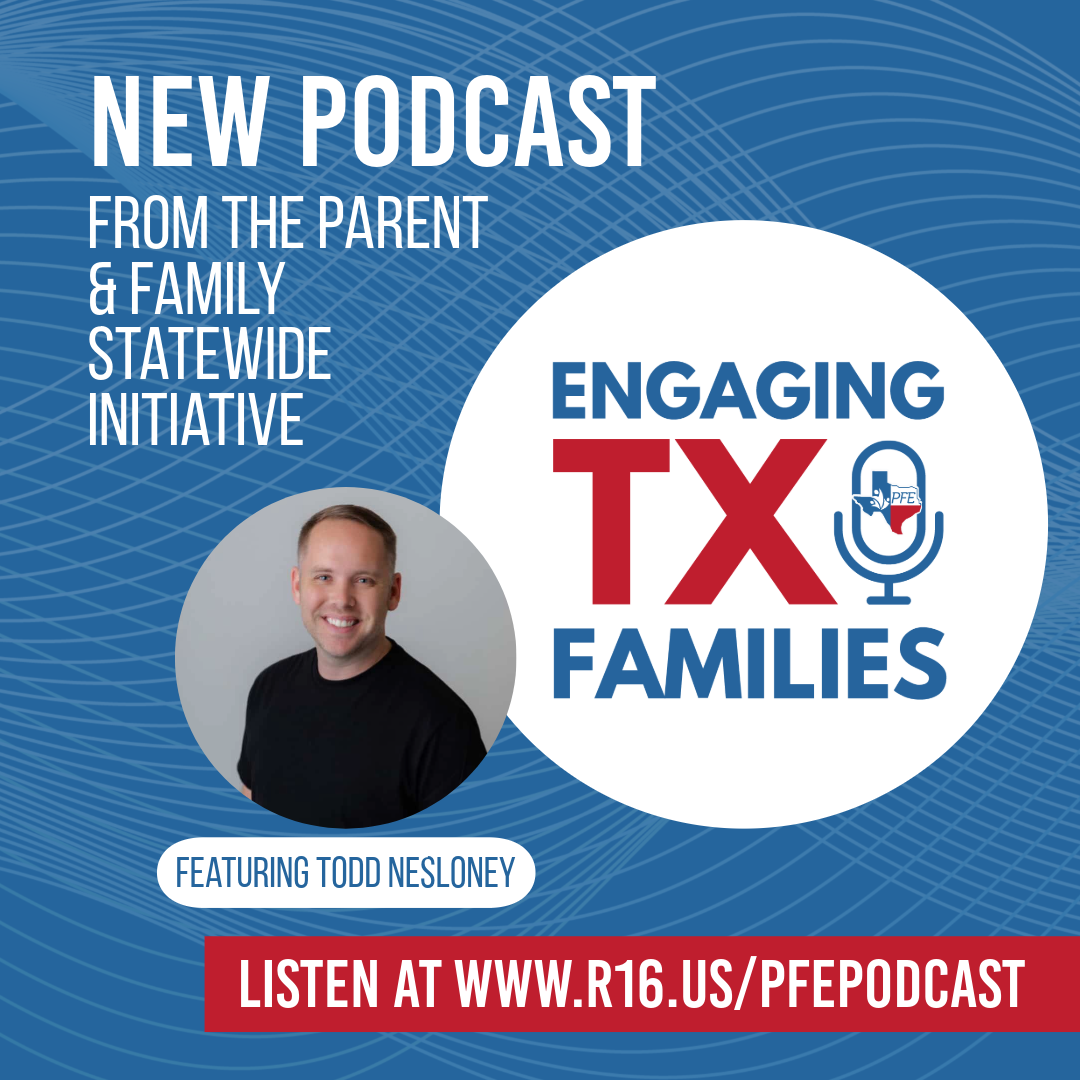
To hear more from a principal’s perspective, listen to Todd Nesloney on the Engaging Texas Families Podcast.

1. The "Dual Capacity" Compass (Visual Summary)
Why it’s worth 5 minutes: This is the "North Star" of family engagement. Instead of a long paper, this site provides a clear graphic that shows how to move from "traditional" engagement (bake sales and flyers) to "partnership" engagement (co-educators). It helps you see the "Why" behind the "How."
2. Edutopia: "A Family Communication Strategy That Works"
Why it’s worth 5 minutes: This article breaks down the Kraft & Rogers research into actionable steps. It explains why "one-sentence" messages are often more effective than long newsletters and gives specific examples of how to bridge the communication gap with high school families.
3. The Funds of Knowledge Toolkit (Practical Guide)
Resource: Funds of Knowledge Toolkit for Educators
Why it’s worth 5 minutes: If you liked the "Home Input Survey" in the newsletter, this toolkit is the "pro" version. It provides a simple matrix (Page 4) to help you categorize what you learn from families—like their hobbies, work skills, or cultural traditions—and turn those into lesson hooks.
Works Cited:
Epstein, Joyce L. School, Family, and Community Partnerships: Your Handbook for Action. 4th ed., Corwin Press, 2018.
Hattie, John. Visible Learning: A Synthesis of Over 800 Meta-Analyses Relating to Achievement. Routledge, 2009.
Henderson, Anne T., and Karen L. Mapp. A New Wave of Evidence: The Impact of School, Family, and Community Connections on Student Achievement. National Center for Family and Community Connections with Schools, 2002.
Kraft, Matthew A., and Todd Rogers. "The Misperceived Return to Parent Engagement for Low-Achieving Students." Journal of Educational Psychology, vol. 107, no. 3, 2015, pp. 819–33.
Mapp, Karen L., and Paul J. Kuttner. Partners in Education: A Dual Capacity-Building Framework for Family-School Partnerships. SEDL, 2013.
Moll, Luis C., et al. "Funds of Knowledge for Teaching: Using a Qualitative Approach to Connect Homes and Classrooms." Theory Into Practice, vol. 31, no. 2, 1992, pp. 132–41.